

Apple has partnered with Alibaba to integrate the Qwen AI model into Apple Intelligence for iOS 27.3. Discover what this global expansion means for privacy and hardware.
When Apple officially introduced Apple Intelligence to Western smartphone users, it ignited an intense international debate regarding whether the tech giant could successfully navigate the complex geopolitical and regulatory hurdles required to deploy its on-device artificial intelligence across the globe.
To close out late October 2026, Apple provided a historic answer that fundamentally reshapes the global consumer AI race. In a landmark strategic partnership announced alongside Chinese e-commerce and cloud infrastructure titan Alibaba Group, Apple confirmed that Alibaba’s flagship open-weight artificial intelligence architecture, Qwen, will serve as the localized foundation powering Apple Intelligence across mainland China. Beginning with the developer beta rollout of iOS 27.3 on November 4 and public release scheduled for December, millions of iPhone users in the world’s largest smartphone market will finally gain access to native generative tools tailored to their regional language and cultural nuances.
For consumer electronics analysts, software engineers, and everyday tech enthusiasts, this collaboration represents far more than a simple localized software update; it provides a fascinating blueprint for how multinational hardware manufacturers must balance strict regional data sovereignty laws with unified consumer software ecosystems.
Overcoming the Regulatory Moat: Why Apple Chose Alibaba Qwen
Deploying advanced artificial intelligence software in major overseas markets is vastly different from rolling out standard operating system updates. In regions with strict cybersecurity and generative algorithm governance—such as China’s Cyberspace Administration—every public-facing large language model must pass rigorous administrative audits verifying training data compliance, content safety, and local data residency.
Apple’s default Western partnership with OpenAI’s ChatGPT could not legally function within these regional borders. Instead of retreating from international flagship markets, Apple pursued a hybrid architectural strategy:
- Decoupling On-Device Silicon From the Cloud: Routine computational tasks—such as contextual auto-complete, notification prioritization, and local photo edits—continue to run natively on Apple’s specialized Neural Engine microchips.
- Selecting a Vetted Regional AI Partner: For complex queries requiring external generative knowledge, Apple selected Alibaba’s Qwen framework, which had already secured full administrative clearance and proven its prowess across multilingual reasoning benchmarks.
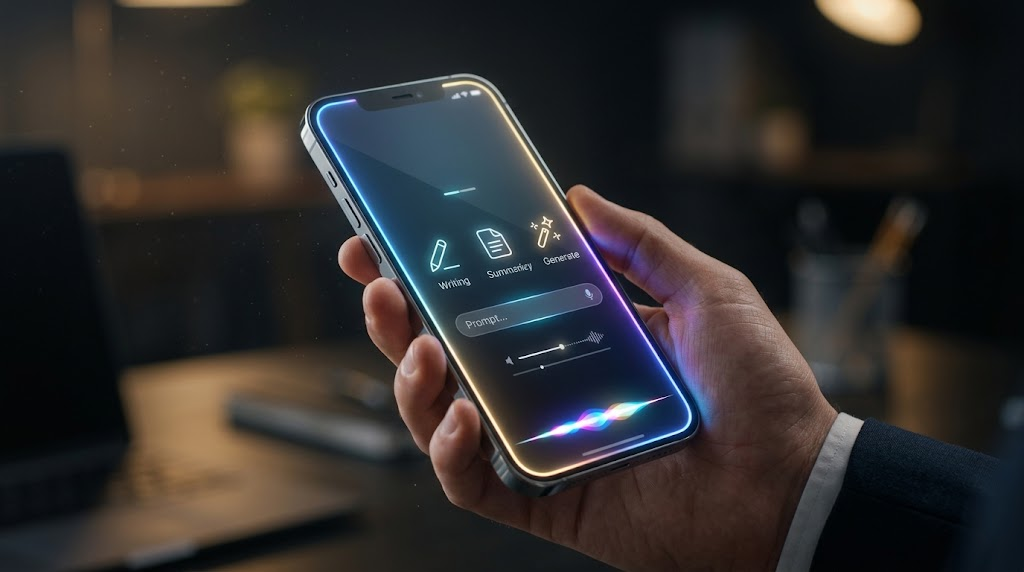
- System-Wide Deep Integration: Rather than operating as an isolated third-party app, Qwen is wired directly into the operating system’s native Writing Tools, Visual Intelligence viewfinder, and system-level Siri voice assistants.
- Preserving the Core User Experience: An iPhone user in Shanghai or Beijing will interact with the exact same visual design, haptic animations, and intuitive UI sliders as an iPhone user in New York or London.
Inside the Feature Suite: What iOS 27.3 Delivers to Daily Users
The rollout of iOS 27.3 brings the full suite of modern generative utilities directly into the hands of international consumers without requiring subscription paywalls or complex technical setups.
Here is a breakdown of the core intelligence tools arriving on supported hardware:
- System-Wide Contextual Writing Tools: Available across native Mail, Notes, Messages, and third-party communication apps, users can automatically rewrite draft emails in formal or casual tones, summarize sprawling group message threads into concise bulleted digests, and proofread technical documents for subtle grammatical phrasing.
- On-Screen Visual Intelligence: Leveraging the physical Camera Control sensor on modern handsets, users can point their smartphone lens at a restaurant facade to pull up opening hours and verified dining reviews, or scan an event flyer to populate calendar appointments automatically.
- Clean Up in Photos: Utilizing local machine learning models running directly on device memory, users can tap or brush over distracting background photobombers, glare reflections, or power lines to eliminate them seamlessly while preserving realistic texture and shadow gradients.
- Natural Conversational Voice Processing: The virtual assistant gains natural language comprehension, allowing users to stumble over spoken words, self-correct mid-sentence, and reference context from prior interactions without triggering awkward system errors.
The Engineering Challenge: Reconciling Privacy With External Cloud Processing
The most delicate technical challenge facing Apple’s engineering teams has always been maintaining its reputation for uncompromising user privacy while piping complex generative prompts to third-party server farms.
Apple’s solution relies on an architectural firewall known as Private Cloud Compute:
- Local Processing as the Priority: The operating system evaluates every incoming user request. If a query can be solved using the on-device 16-core Neural Engine, your personal information never leaves the physical silicon of your smartphone.
- Explicit User Permission Prompts: Whenever a complex research question or generative creative prompt requires consulting Alibaba’s Qwen cloud models, the smartphone displays an explicit confirmation dialog asking whether the user consents to sharing the specific text.
- Cryptographic Ephemeral Sessions: Data transmitted to server clusters is cryptographically blinded. IP addresses are masked, prompts are not retained on server storage disks, and user data is strictly quarantined from being used to train future public machine learning models.

Silicon Requirements: Why Memory Bandwidth Dictates Hardware Eligibility
While the software rollout is generating massive excitement, it also highlights the rigid physical constraints of running billion-parameter language models directly on mobile hardware.
Consumers frequently ask why older smartphone models cannot simply download these generative software features via a standard wireless update. The answer comes down to physical unified memory architecture:
- The 8GB RAM Floor: Running compressed neural models continuously in background RAM requires at least 8 gigabytes of ultra-fast unified memory. Handsets equipped with 6GB or less simply lack the physical memory bandwidth to hold language models in standby without terminating background applications.
- Neural Engine Throughput: The dedicated neural processing units built into modern flagship chips execute trillions of operations per second while drawing minimal battery wattage, preventing device overheating during sustained text generation.
- Accelerating the Hardware Upgrade Cycle: By reserving advanced intelligence features for modern hardware tiers, Apple is creating a compelling technological incentive for consumers holding older phones to upgrade ahead of the holiday retail season.
4 Strategic Takeaways for the Global Tech Economy
The partnership between Cupertino and Hangzhou signals a new chapter in multinational corporate diplomacy and software distribution:
- The Era of Monolithic Global AI Is Over: Multinational technology companies cannot enforce a single, worldwide AI model. Future consumer platforms must adopt modular, plug-and-play architectures that integrate different regional language engines based on local legal jurisdictions.
- Open-Weight Models Are Winning Enterprise Adoption: Alibaba’s Qwen has proven that well-trained, open-source-rooted foundational models can compete directly with closed proprietary systems on real-world consumer hardware.
- Hardware Differentiation Moves to Silicon: As base generative algorithms become commoditized utilities, the ultimate competitive battleground shifts back to physical silicon efficiency, thermal design, and on-device battery conservation.
- Consumer Trust Remains the Deciding Metric: Winning long-term consumer loyalty requires complete transparency regarding how personal data is handled, making local on-device processing the gold standard of mobile computing.