
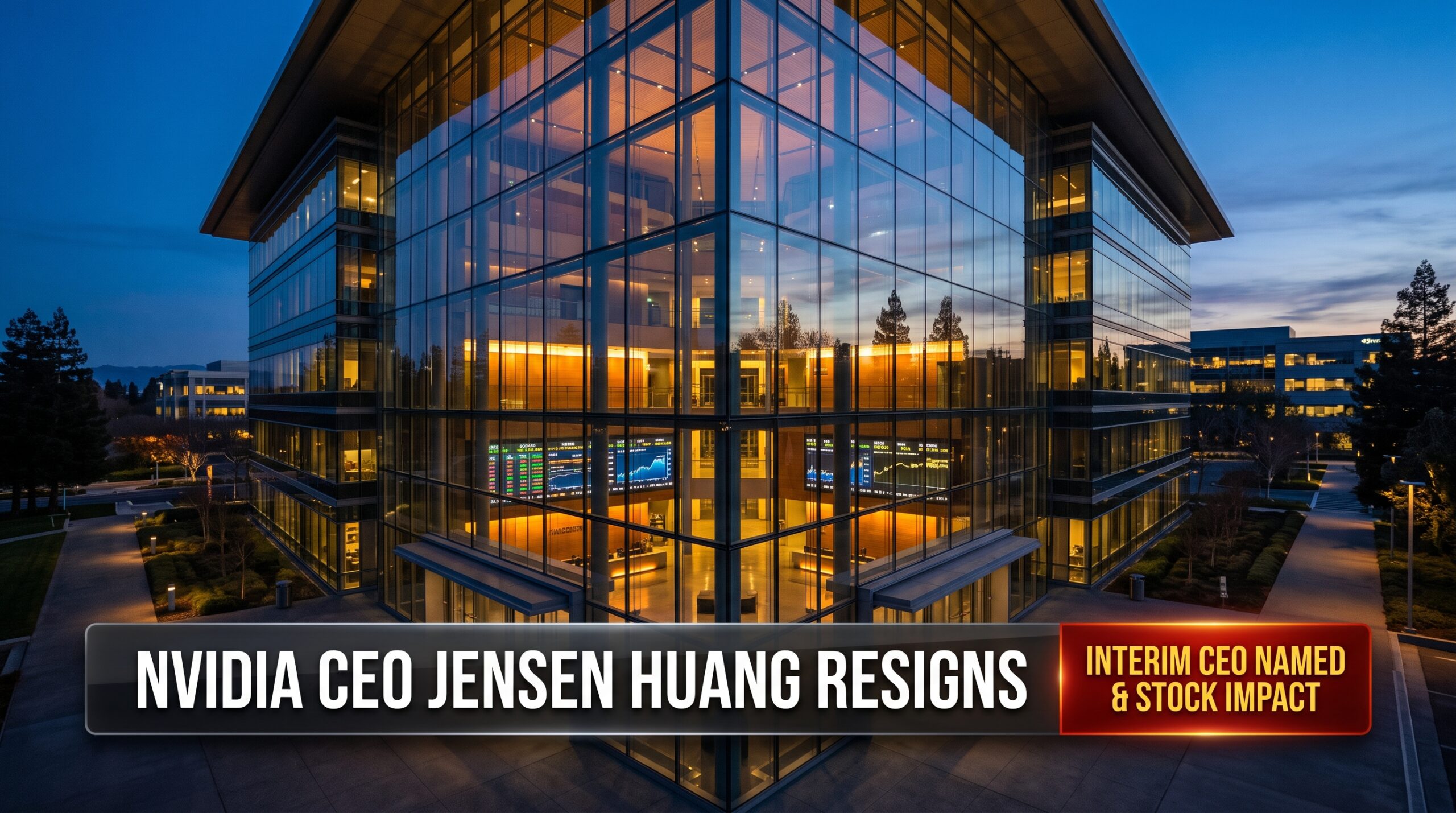
Nvidia co-founder Jensen Huang has resigned as CEO after 33 years, naming CFO Colette Kress as interim chief. Explore the stock impact, export concerns, and what comes next.
If you have followed the stock market over the past three years, you already know that few corporate leaders have ever been as closely tied to a single company’s identity as Jensen Huang was to Nvidia.
On Thursday, November 12, 2026, that three-decade partnership came to an abrupt, stunning end. Nvidia officially announced that co-founder and longtime CEO Jensen Huang had stepped down as chief executive, president, and member of the board of directors, effective immediately. The resignation brings a sudden close to a 33-year run that transformed a modest graphics-card startup into a $4 trillion artificial intelligence powerhouse.
Stepping into the breach on an interim basis is Chief Financial Officer Colette Kress, a steady corporate veteran who has managed Nvidia’s finances since 2013. For everyday investors holding index funds, retirement accounts, or individual semiconductor shares, the sudden departure raises urgent questions about corporate governance, national security scrutiny, and whether Nvidia’s unmatched hardware dominance can hold steady without its famous founder.
Inside the Leadership Shakeup: Why Huang Stepped Down
Corporate exits at the top of a $4 trillion enterprise rarely happen overnight without intense behind-the-scenes pressure. Huang’s resignation followed days of mounting boardroom scrutiny, shareholder lawsuits, and federal national security inquiries.
Reports surfacing earlier in the week revealed that the 63-year-old executive had been involved in two separate extramarital relationships that created severe compliance and national security headaches for the Silicon Valley chipmaker:
- National Security and Export Concerns: One relationship involved a former top executive at Megaspeed International, a Singapore-based cloud computing firm that partnered prominently with Nvidia. U.S. intelligence officials reportedly suspected the executive of gathering sensitive intelligence for Beijing, triggering an active FBI review into whether high-end AI chips were being routed around U.S. export restrictions.
- Internal Workplace Conduct: Just twenty-four hours before his resignation, additional reporting detailed a second workplace relationship involving a senior Nvidia healthcare executive who reported directly to him. That revelation violated internal corporate governance standards and eroded remaining board support.
- No Immediate Permanent Successor: Nvidia’s board confirmed that it did not have an immediate permanent successor lined up. Directors have launched an aggressive formal search evaluating both internal engineering leaders and external Fortune 500 technology executives.

Wall Street’s Reaction: Trillion-Dollar Volatility in Real Time
Because Nvidia makes up a massive slice of the S&P 500 and the Nasdaq Composite, any tremor in Santa Clara sends immediate shockwaves through global retirement portfolios.
When Wall Street opened for trading on Thursday morning, panic selling initially wiped out massive market value before institutional buyers stepped in to stabilize the drop:
- The Opening Bell Plunge: Nvidia shares dropped as much as 13 to 14 percent in early morning trading, briefly erasing hundreds of billions in market capitalization within minutes of the opening bell.
- Partial Afternoon Rebound: By the closing bell on Thursday, the stock recovered a portion of its steep morning losses to finish down 4.3 percent at $163.91 per share—still wiping more than $180 billion off the company’s market value in a single session and roughly $490 billion over the course of the week.
- Ripple Effects Across AI Infrastructure: Downstream partners and cloud infrastructure providers tied closely to Nvidia’s hardware rollout—including server makers and specialized AI cloud hosts—also faced sharp selling pressure as traders reassessed short-term supply chain timelines.
- The 52-Week Context: Following the weekly slide, Nvidia shares now sit roughly 27.6 percent below their October 6 all-time high of $243.37, putting the stock squarely in technical correction territory.

Who Is Interim CEO Colette Kress?
With the founder gone and investors nervous, the board turned to the steady hand sitting right inside the executive suite. Colette Kress isn’t a flashy Silicon Valley showman; she is a seasoned financial operator who knows every gear inside Nvidia’s global supply chain.
Her background explains why Wall Street took some comfort in her interim appointment:
- Over a Decade at Nvidia: Joining as Executive Vice President and CFO in 2013, Kress helped steer Nvidia through the cryptocurrency mining booms, the gaming GPU shortages, and the explosive rise of generative AI data centers.
- Deep Enterprise Tech Pedigree: Before arriving in Santa Clara, Kress spent thirteen years in senior financial leadership roles at Microsoft and three years at Cisco, giving her deep credibility with Fortune 500 CIOs and institutional Wall Street analysts.
- Keeping Dual Responsibilities: Kress will continue handling her existing duties as Chief Financial Officer while stepping into the interim chief executive seat, ensuring continuity ahead of Nvidia’s upcoming quarterly earnings disclosures and Singapore revenue reporting updates.
National Security and the U.S.-China Chip Race
Beyond Wall Street share prices, Huang’s sudden exit carries heavy geopolitical consequences. Over the past two years, Nvidia sat directly in the crosshairs of U.S.-China technology competition, balancing Washington’s strict semiconductor export bans against massive international demand.
Federal lawmakers and policy analysts are watching three critical issues closely:
- Enforcement Gaps in Export Controls: Lawmakers are demanding tighter oversight on how cloud firms operating in Southeast Asia and Singapore access and rent high-end Blackwell and Hopper graphics processors to overseas entities.
- Foreign Intelligence Targeting: The controversy serves as a stark warning to every major U.S. defense, semiconductor, and AI firm regarding how aggressively foreign intelligence services target senior American corporate executives.
- Protecting Nvidia’s Software Moat: While Huang was the public face of Nvidia, the company’s true competitive fortress isn’t just silicon—it’s CUDA, the proprietary software ecosystem that millions of AI developers rely on daily. Keeping engineering morale high during a leadership transition is now Kress’s top operational priority.
4 Practical Takeaways for Everyday Investors
When one of the world’s largest companies loses its iconic founder, it’s easy to make emotional decisions with your portfolio. Keep these four grounded rules in mind:
1. Don’t Panic-Sell Into Opening-Bell Volatility
Thursday’s trading session offered a textbook lesson in why retail investors shouldn’t place market sell orders at 9:30 a.m. Those who panicked at the 14 percent morning drop locked in steep losses, while patient investors watched the stock recover nearly two-thirds of that drop before the closing bell.
2. Separate Leadership Scandals From Core Hardware Demand
Corporate scandals hurt brand trust and trigger short-term multiple compression, yet hyperscale tech giants still need millions of graphics chips to power their cloud data centers. Watch upcoming quarterly order backlogs and data center margins rather than relying solely on cable news headlines.
3. Check Your Index Fund Concentration
Even if you don’t own individual shares of Nvidia, chances are it’s one of the largest holdings inside your S&P 500 or Nasdaq-100 retirement index fund. If your portfolio feels overly exposed to mega-cap semiconductor swings, reviewing your broader asset allocation toward healthcare, utilities, or short-term Treasury funds can smooth out volatility.
4. Watch the Permanent CEO Search Closely
The market will reward stability. Expect sharp relief rallies if Nvidia’s board appoints a respected, proven engineering and operations leader—whether promoted internally from Nvidia’s deep executive bench or recruited from another top-tier technology giant.