
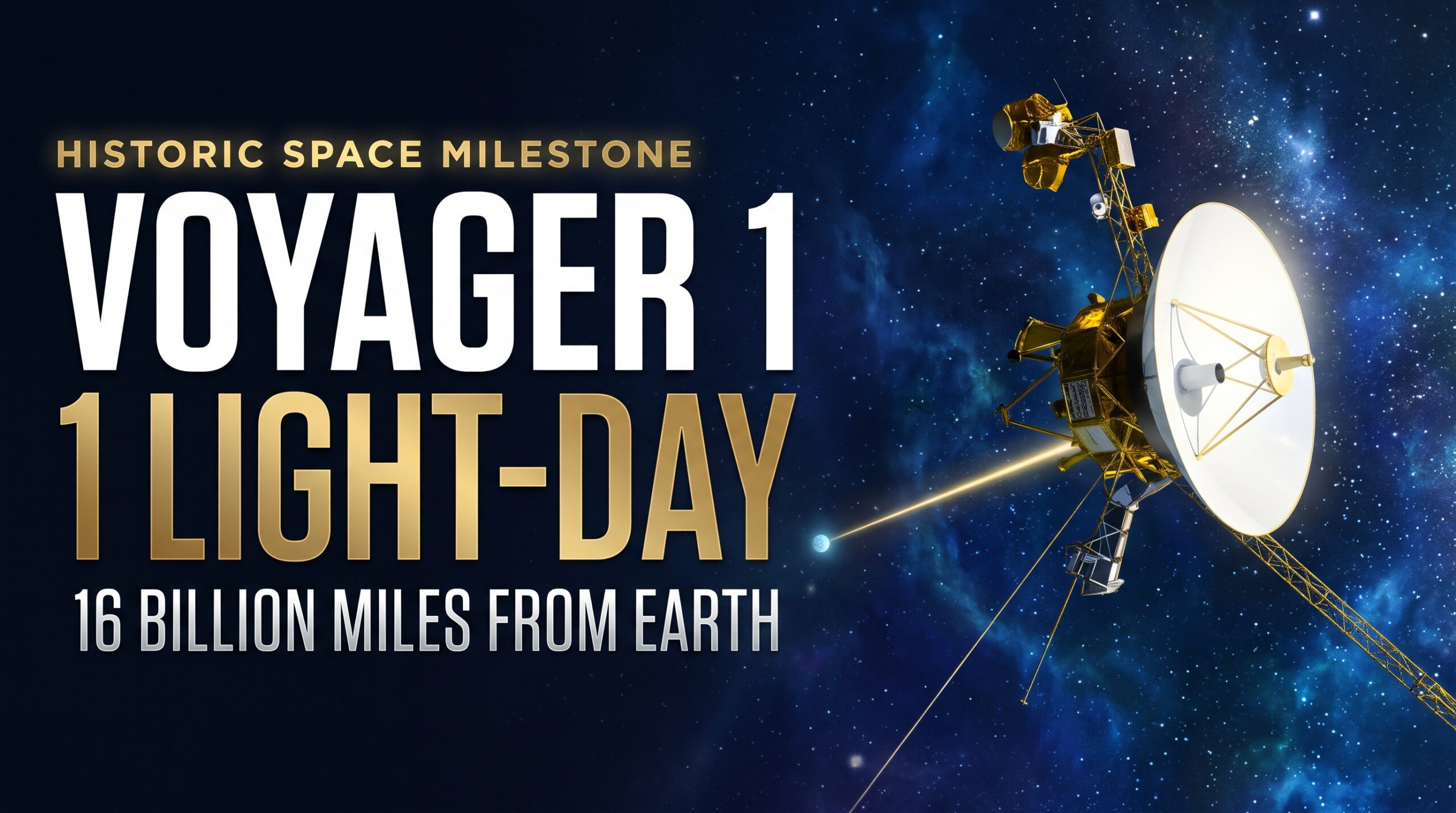
NASA’s Voyager 1 spacecraft officially reached one light-day—over 16 billion miles—from Earth on November 18, 2026. Explore the science, signals, and legacy.
At 5:16:07 a.m. Eastern Time today, November 18, 2026, a spacecraft launched nearly half a century ago quietly crossed a boundary no human-built machine has ever reached. NASA’s Voyager 1 probe officially arrived at one light-day from Earth—a staggering distance of 16.094 billion miles (25.902 billion kilometers) out in deep interstellar space.
To put that number into perspective, sunlight takes roughly eight minutes to travel from the Sun to Earth, and just over four hours to reach Neptune, the outermost major planet in our solar system. At Voyager 1’s current position, even a radio signal racing through the vacuum of space at 186,000 miles per second now requires a full 24 hours just to arrive at the spacecraft—and another 24 hours for a reply to travel back to Earth.
Launched in September 1977 on what was originally planned as a four-year survey of Jupiter and Saturn, Voyager 1 has now spent 49 years, two months, and 11 days hurtling outward through the cosmos. Today’s milestone underscores both the brilliance of 1970s engineering and humanity’s enduring curiosity about what lies beyond our solar neighborhood.
What Does “One Light-Day” Actually Mean?
Despite the word “day” in its name, a light-day is strictly a measurement of distance, not time. Just as a light-year measures how far a beam of light travels in one Earth year, a light-day measures the exact distance light covers in 24 hours.
- The Speed of Light: Light moves through empty space at approximately 186,282 miles per second (nearly 300,000 kilometers per second).
- 24-Hour Total: Over 86,400 seconds in a single day, that beam covers roughly 16.094 billion miles.
- Voyager 1’s Pace: Hurtling outward at roughly 38,000 miles per hour (61,000 kilometers per hour) relative to the Sun, Voyager 1 needed nearly 50 years to cover the same distance that a beam of light crosses between sunrise today and sunrise tomorrow.
- Sun vs. Earth Reference: Because Earth continuously orbits the Sun, Voyager 1’s distance from our planet fluctuates slightly throughout the year. While the probe crossed one light-day from Earth today, it is projected to cross one light-day from the Sun itself on February 3, 2027.
Meanwhile, Voyager 1’s twin spacecraft, Voyager 2—launched 16 days earlier in 1977 on a different planetary trajectory that included historic flybys of Uranus and Neptune—is not expected to reach the one-light-day mark from Earth until November 2035.
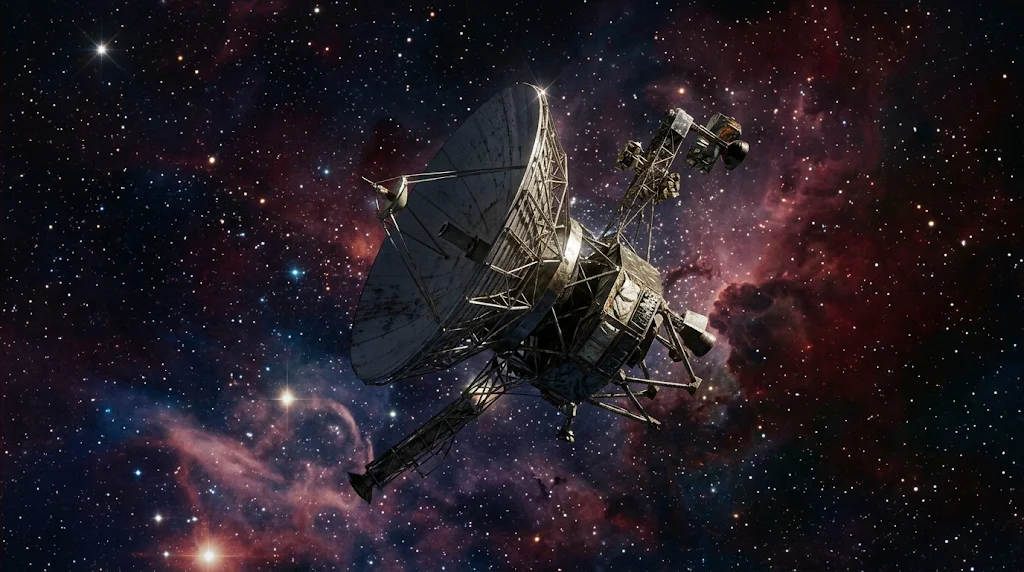
Talking Across 16 Billion Miles: How NASA Still Hears Voyager 1
Communicating with an aging spacecraft operating 170 times farther from Earth than our planet sits from the Sun requires extraordinary precision. By the time Voyager 1’s faint radio transmission reaches Earth, its signal strength is measured in fractions of a billionth of a billionth of a watt.
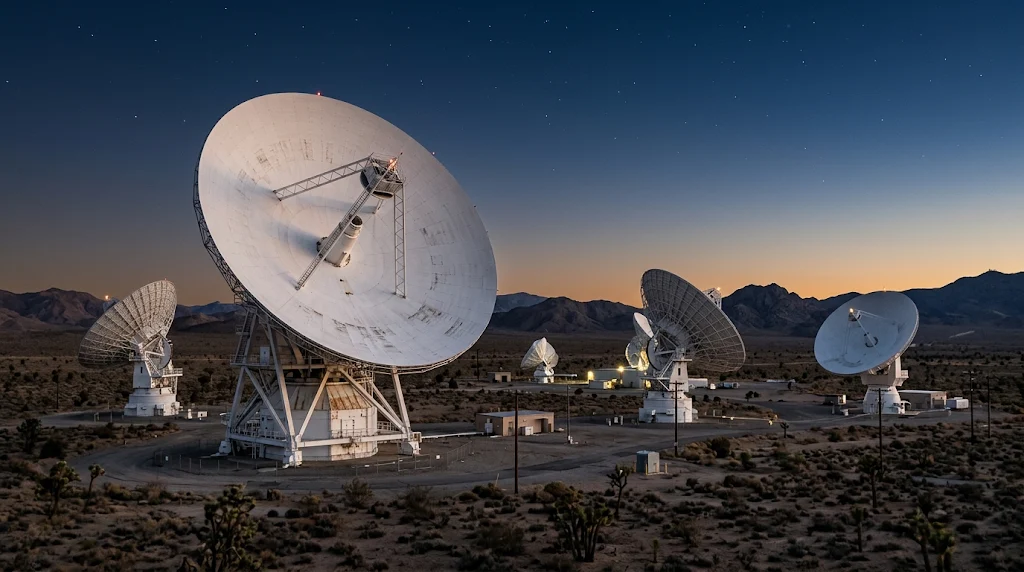
To catch that whisper against the background noise of the galaxy, mission engineers rely on NASA’s Deep Space Network (DSN)—giant parabolic radio telescope dishes stationed in California, Spain, and Australia. Every week, a small operations team at the Jet Propulsion Laboratory, supported by retired engineers who originally built the spacecraft, transmits carefully scripted commands outward.
Because of today’s milestone, every single interaction now carries a mandatory 48-hour round-trip wait:
- Hour 0: Engineers transmit a software command or diagnostic query from a giant dish on Earth.
- Hour 24: Traveling at the speed of light, the radio wave finally washes over Voyager 1’s 12-foot-wide high-gain dish antenna.
- Hour 48: If the spacecraft executes the command and beams telemetry homeward, ground controllers receive confirmation two full days after pressing send.
Maintaining that link requires constant power management. Voyager 1 draws electricity from plutonium-powered radioisotope thermoelectric generators whose output steadily drops each year. To keep the main transmitter and remaining science instruments alive, engineers have systematically switched off non-essential heaters and cameras—including turning off the probe’s imaging cameras back in 1990 shortly after it snapped the famous “Pale Blue Dot” portrait of Earth from 3.7 billion miles away.
Life Outside the Heliosphere: What Voyager 1 Has Discovered
Voyager 1 is not merely drifting through empty darkness; it is actively sampling a region of space humans have never touched before. In August 2012, the spacecraft officially crossed the heliopause—the outer boundary of the Sun’s protective magnetic bubble, known as the heliosphere—becoming the first human-made object to enter interstellar space.
Even with a pared-down suite of active sensors, the probe continues delivering irreplaceable scientific data back to Earth:
- Cosmic Ray Measurements: Outside the Sun’s magnetic shield, Voyager 1 measures raw galactic cosmic rays radiating from distant supernovae, giving physicists an unfiltered baseline of the radiation environment between stars.
- Interstellar Plasma Density: Its plasma wave instrument detects subtle vibrations in the thin gas drifting between star systems, revealing unexpected density spikes and shock waves rippling through the Milky Way.
- Magnetic Field Orientation: Magnetometer readings show how the Sun’s magnetic field hands off to the broader interstellar magnetic field—data that helps astrophysicists map our solar system’s place inside the local galaxy.
As original project manager John Casani famously summarized the design philosophy behind the twin probes: engineers didn’t build them to last 30 or 40 years—they designed them not to fail.
The Golden Record and a 40,000-Year Cosmic Journey
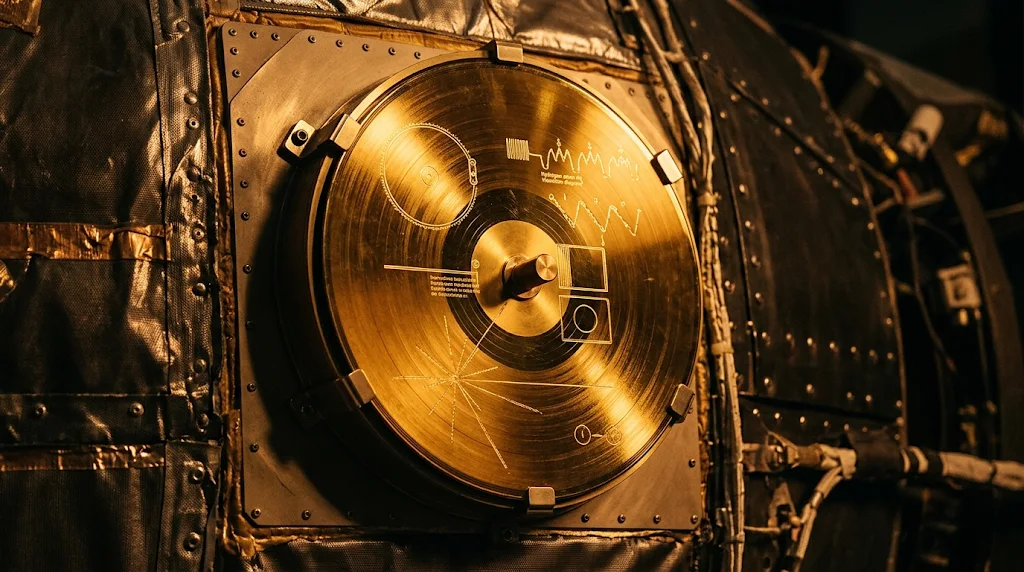
Bolted securely to Voyager 1’s aluminum frame sits one of the most poetic artifacts ever sent off-planet: the Golden Record. Crafted from gold-plated copper and sealed inside a protective aluminum cover etched with playback instructions and a pulsar star map, the 12-inch phonograph disc serves as a time capsule from Earth in 1977.
Curated by a committee chaired by astronomer Carl Sagan, the record carries:
- Spoken greetings in 55 languages.
- Natural Earth sounds including whale songs, thunder, surf, and a human heartbeat.
- 90 minutes of diverse music ranging from Bach and Beethoven to Chuck Berry’s “Johnny B. Goode” and traditional melodies from around the globe.
- 115 encoded photographs illustrating human life, architecture, DNA, and mathematics.
Within the next decade, Voyager 1’s nuclear power supply will finally drop too low to keep its radio transmitter running. Once its signal falls silent, the spacecraft will continue gliding silently through the Milky Way at 38,000 miles per hour. Roughly 40,000 years from now, Voyager 1 will pass within 1.7 light-years of a star known as Gliese 445 (AC +79 3888) in the constellation Ursa Minor—long after human civilizations on Earth have transformed beyond recognition.