

Meta VR glasses explained: learn how Meta’s smart glasses, Quest headsets and emerging wearable technology are reshaping the future of computing.
If you search for “Meta VR glasses,” you might expect to find one futuristic pair of glasses that puts a complete virtual world in front of your eyes.
The reality is a little more interesting.
Meta’s wearable strategy covers several different technologies, from Ray-Ban Meta smart glasses that look and feel like ordinary sunglasses to Meta Quest VR headsets designed for immersive virtual reality. The company is also working on more advanced augmented-reality technology that could eventually make digital information feel much more naturally connected to the real world.
That makes the phrase “Meta VR glasses” somewhat confusing—but it also points toward one of the biggest questions in consumer technology: What will happen when computers become something we wear instead of something we hold?
What Are Meta VR Glasses?
Meta doesn’t currently have one mainstream consumer product officially called “Meta VR Glasses.”
Instead, the company has built a broader ecosystem around virtual reality, mixed reality, artificial intelligence and smart glasses.
The easiest way to understand the lineup is to separate it into two categories:
- Meta Quest: Headsets designed primarily for virtual and mixed reality.
- Ray-Ban Meta: Lightweight smart glasses designed for everyday use, with cameras, microphones, speakers and AI features.
Meta Quest headsets place digital environments directly in front of your eyes. Ray-Ban Meta glasses take a different approach: they keep your normal vision while adding cameras, audio and AI-powered features.
That distinction is important if you’re shopping for wearable technology.
Meta Quest Is the VR Side of the Equation
The Meta Quest family is much closer to what most people traditionally mean when they hear “VR glasses.”
The headset uses displays positioned in front of your eyes and tracks your movements so digital environments can respond as you move. Depending on the model and software, users can play games, watch immersive content, exercise and interact with mixed-reality experiences.
The Quest platform has also moved beyond pure virtual reality by incorporating mixed reality, allowing digital objects and experiences to appear alongside the physical environment.


Ray-Ban Meta Glasses Are a Different Kind of Wearable
For everyday consumers, Ray-Ban Meta glasses may actually be the more interesting product.
They don’t look like traditional VR headsets. Instead, they resemble conventional Ray-Ban sunglasses or eyeglasses while hiding technology inside the frames.
Depending on the model and configuration, the glasses can include cameras, microphones, open-ear speakers and touch controls.
That allows users to capture photos and videos from a first-person perspective, listen to audio, make calls and interact with Meta’s AI assistant.
The appeal is obvious: you don’t have to put a bulky headset over your face.
You simply wear the glasses.
Why Cameras Make Smart Glasses Different
One of the most useful ideas behind smart glasses is the ability to capture what you’re seeing without reaching for a phone.
Imagine walking through a new city and wanting to remember a particular building. Instead of pulling your smartphone from your pocket, you can potentially use the glasses to capture the moment.
The same concept applies to travel, family events, outdoor activities and everyday moments.
But cameras mounted on glasses also raise an important issue: privacy.
People around you may not immediately know whether you’re recording. That’s why responsible use, visible recording indicators and clear social norms are likely to remain important as wearable cameras become more common.
What Can Meta AI Do on Smart Glasses?
Artificial intelligence is becoming one of the biggest reasons consumers may want smart glasses.
Rather than functioning simply as a camera and Bluetooth speaker, newer Meta glasses can connect users with Meta’s AI technology.
Depending on available features and region, users can interact with the assistant through voice commands and ask questions about things they’re seeing or doing.
That opens up a much broader possibility for wearable computing.
Instead of opening an app and typing a question, you could eventually ask an assistant while keeping your hands free.
The Phone May Not Disappear—But It Could Become Less Important
It’s unlikely that smart glasses will completely replace smartphones anytime soon.
Phones remain better suited for typing, detailed editing, banking, gaming, reading long documents and dozens of other tasks.
But glasses could handle quick interactions.
Think:
- “Take a picture.”
- “Call Mom.”
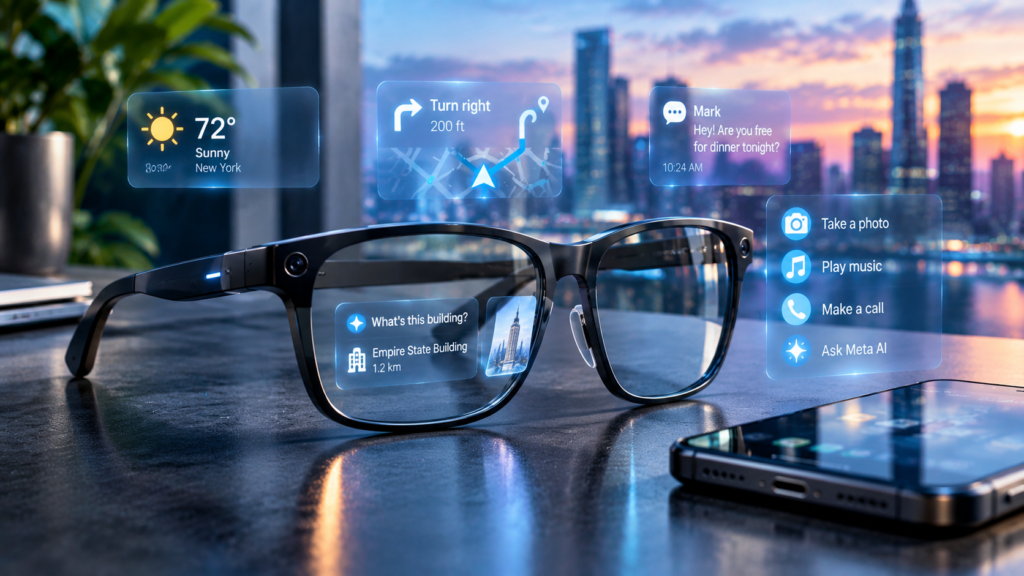
- “What building am I looking at?”
- “Remind me where I parked.”
- “Translate this sign.”
- “Play my music.”
That is where wearable AI becomes particularly compelling.

Are Meta VR Glasses Actually Augmented Reality Glasses?
This is where the terminology gets tricky.
Virtual reality generally replaces your view of the physical world with a digital environment.
Augmented reality, by contrast, adds digital information to your view of the real world.
Mixed reality sits somewhere between the two, allowing digital content and physical surroundings to interact.
Meta’s long-term ambitions extend beyond today’s smart glasses.
The company has publicly demonstrated prototype technologies designed to push toward more advanced AR experiences. Its Orion prototype, for example, represents Meta’s vision for lightweight augmented-reality glasses capable of displaying digital content while users continue seeing the physical world.
Orion is not simply another pair of consumer sunglasses sitting on store shelves. It represents the direction Meta is exploring for future computing.
And that distinction matters.
What Could Future Meta Glasses Do?
The long-term vision is considerably more ambitious than taking photos or playing music.
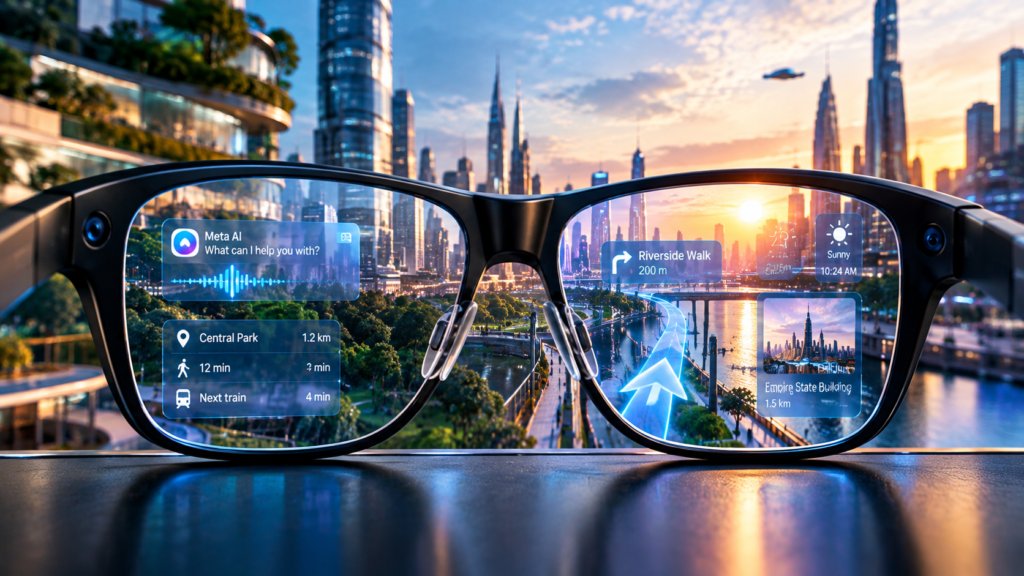
Future AR glasses could potentially place digital information directly into your field of view.
A navigation arrow could appear over the street ahead.
A translation could appear alongside a foreign-language sign.
A video call could potentially become a spatial experience rather than a rectangle on a phone screen.
Work applications could display information without requiring a traditional monitor.
The biggest challenge is making all of this work in a package that is comfortable, attractive, powerful and practical enough to wear all day.
That’s a much harder engineering problem than it sounds.

The Biggest Challenges Facing Meta’s Glasses
The technology is exciting, but there are still major obstacles.
Battery Life
Small frames have limited room for batteries and electronics. More cameras, displays and AI processing require more power, which creates a constant battle between features and battery life.
Privacy
Wearable cameras introduce questions that smartphones don’t always create in the same way. People may feel uncomfortable being recorded by someone wearing a seemingly ordinary pair of glasses.
Comfort and Design
Nobody wants to wear a computer that feels like a computer.
For smart glasses to become genuinely mainstream, they need to look good, remain lightweight and feel comfortable for hours.
Price
Advanced sensors, processors, cameras and displays aren’t cheap. Future AR glasses could remain expensive until manufacturing technology improves and the market reaches greater scale.
Should You Buy Meta Glasses or a VR Headset?
It depends entirely on what you want to do.
If your priority is immersive gaming, virtual worlds, fitness experiences and mixed reality, a Meta Quest headset is the more relevant category.
If you want hands-free photography, music, calls and AI assistance in a familiar glasses format, Ray-Ban Meta-style smart glasses make more sense.
And if you’re waiting for lightweight glasses that combine everyday eyewear with sophisticated AR displays, you’re looking at a future category rather than a straightforward replacement for today’s VR headsets.
The Bigger Picture for Wearable Technology
Meta’s work in this space reflects a larger shift happening across the technology industry.
For decades, computing moved from desktops to laptops, then to smartphones and watches. The next step could involve technology becoming increasingly invisible.
Instead of reaching into a pocket, users could simply speak.
Instead of staring down at a screen, information could eventually appear within the surrounding environment.
We’re not completely there yet.
But the combination of Meta’s smart glasses, Quest headsets and AR research shows why wearable computing has become one of the most closely watched areas in consumer technology.
For now, “Meta VR glasses” is less a single product than a shorthand for a much bigger idea: a future where digital technology moves from the screens we carry to the things we wear.